

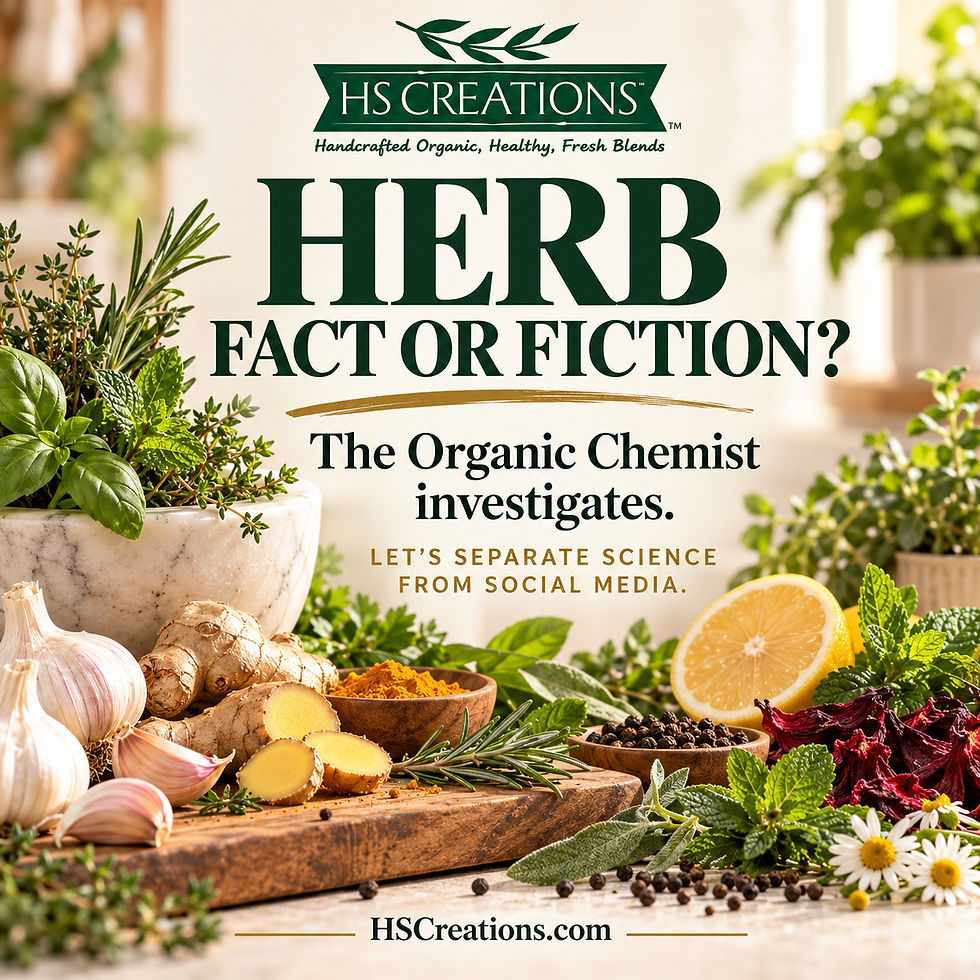
Herb Fact or Fiction?
9 Popular Herbal Claims Under the Microscope,
By The Organic Chemist | HS Creations, LLC
Just because it’s green doesn’t mean the internet got it right. 🌿😂
I recently came across a graphic titled “Herbs You’re Using Wrong.”
Nine herbs. Nine very confident claims.
And naturally, as the founder and creator of HS Creations, I had questions.
I love herbs. I love spices. And I especially love understanding the chemistry behind the ingredients we use every day.
But there’s a big difference between traditional uses, promising scientific research, and proven health benefits.
So let’s investigate!
1. Ashwagandha: Should You Only Take It at Night?
Verdict: Misleading.
Some studies suggest ashwagandha may help with stress and sleep. But there’s no established rule that nighttime is best for everyone.
It’s also important to remember that herbal supplements can have side effects and interactions. Ashwagandha has been linked to rare cases of liver injury.
Natural doesn’t automatically mean risk-free.
2. Ginger: Is Stronger Tea Better?
Verdict: Exaggerated.
Ginger has evidence supporting its use for certain types of nausea.
But making your tea strong enough to frighten your ancestors doesn’t automatically multiply its benefits. 😂
Concentration matters, but stronger isn’t always better.
3. Peppermint: Must You Drink It Before Meals?
Verdict: Unsupported.
Peppermint has a long history of culinary and digestive use.
However, research involving peppermint oil capsules shouldn’t automatically be applied to peppermint tea.
There’s no established rule that drinking peppermint tea before meals prevents bloating better than drinking it afterward.
4. Garlic: Should You Wait Before Cooking?
Verdict: Mostly true!
NOW we’re talking chemistry! 🔬
When fresh garlic is chopped or crushed, an enzyme called alliinase helps convert alliin into allicin.
Allowing chopped garlic to rest briefly before heating can give that reaction time to occur.
Does that mean every garlic dish becomes medicinal? No.
But the chemistry is fascinating.
5. Turmeric: Does It Need Black Pepper?
Verdict: Partly true.
Curcumin, a compound found in turmeric, is poorly absorbed by the body.
Piperine, a compound in black pepper, can increase curcumin absorption under certain conditions.
But improved absorption doesn’t automatically guarantee better health outcomes.
And concentrated supplements are very different from seasoning dinner.
6. Chamomile: Is Ten Minutes the Magic Number?
Verdict: Exaggerated.
Chamomile contains compounds including apigenin, which researchers have studied for potential calming effects.
Steeping time influences extraction, but there’s no scientifically established ten-minute deadline that guarantees deeper sleep.
Your teabag isn’t conducting a clinical trial. 😂
7. Lemongrass: Does Stronger Tea Clear Congestion?
Verdict: Unsupported.
Lemongrass contains aromatic compounds studied for antimicrobial activity in laboratory settings.
But laboratory findings don’t prove that drinking stronger lemongrass tea clears congestion in people.
Wonderful aroma? Absolutely.
Miracle respiratory treatment? Not established.
8. Moringa: Is an Empty Stomach Better?
Verdict: Unsupported.
Moringa leaves contain vitamins, minerals, and other plant compounds.
However, there’s no convincing evidence that consuming moringa on an empty stomach produces superior nutrient absorption or stronger anti-inflammatory effects.
Sometimes food is simply food. And that’s perfectly fine!
9. Hibiscus: Is Hot Tea Healthier Than Iced?
Verdict: Misleading.
Hibiscus has been studied for its potential blood-pressure-lowering effects, with some promising results.
But there’s no established evidence that drinking it warm produces greater blood pressure benefits than drinking it chilled.
Temperature alone doesn’t determine its health effects.
What Did We Learn?
Natural doesn’t automatically mean medicinal.
Stronger doesn’t automatically mean better.
And a beautifully designed infographic doesn’t automatically make something scientifically accurate. 😂
At HS Creations, we’re passionate about organic herbs, spices, flavor, and understanding our ingredients.
We believe good food starts with thoughtful choices, quality ingredients, and curiosity.
We don’t make more. We make better.
And sometimes that means asking one very important question:
Is that actually science, or did somebody just make a really pretty graphic? 🌿🔬
Joanne G. Sakulich
Founder & Creator | The Organic Chemist
HS Creations, LLC
Pure Ingredients. Bold Flavor. Crafted with Care.
Educational note: This article discusses culinary ingredients and herbal research. It is not medical advice. Herbal supplements may interact with medications or cause adverse effects.
Comments